

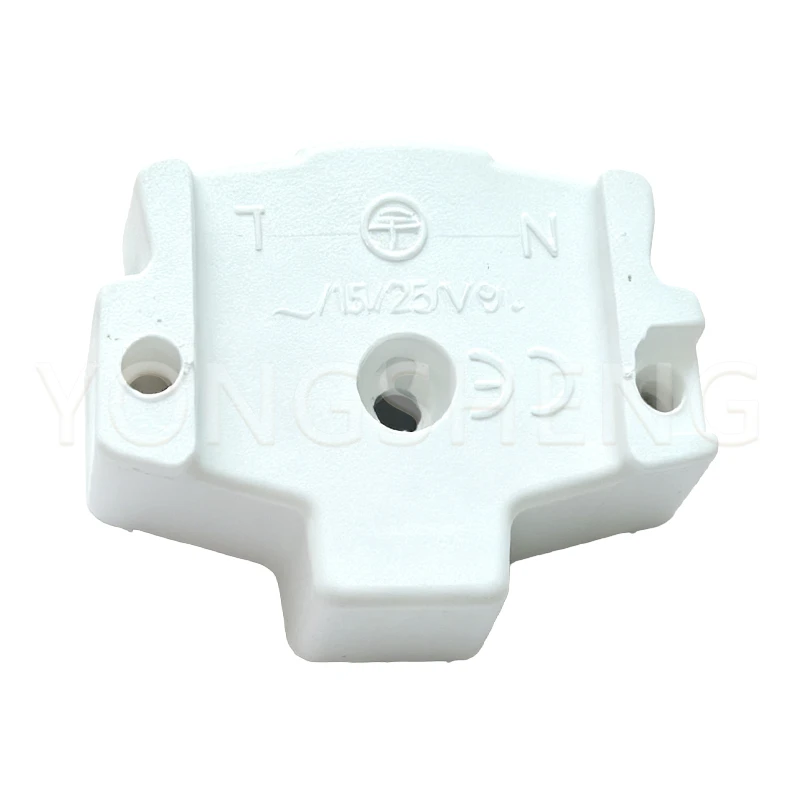
Ceramic Terminal Blocks
Product Description
Ceramic terminal blocks are the mounting bodies that carry screw terminals and keep each pole electrically separate from the next. A block sits on a panel or inside an appliance, takes the pull of the wiring, and provides the barriers and the creepage path between adjacent poles, so the block is as much a part of the insulation system as the terminal itself. Its working features are the pole spacing, the barrier height, the wire entry and the fixing holes, and they have to agree with the terminal, the cable lug and the panel it is screwed to. Blocks are pressed to shape with the barriers formed in the tool, then finished where the terminals seat, so the screw does not sit on a slope.
A terminal block is only useful if the pole spacing matches the terminals you already buy and the holes match the panel you already drill. We build the block to your terminal drawing, with the barriers, the pole pitch and the fixing holes in one tool, and send a sample with terminals fitted before the production run, so a mismatch is found on the bench instead of on the line. The tool stays with your part number, which means the blocks you receive next year still take the same terminal and still fit the same panel without redrilling.
Product Description

Application 1. Motor junction boxes. A junction box concentrates several conductors in a small volume and vibrates in service. A single pressed body keeps the bores at fixed spacing under vibration, and the alumina wall between them resists the arc that follows a loose connection.
Application 2. Appliance wiring compartments. Heating appliances put the terminal block close to the element, where a thermoplastic body would soften. Alumina holds its shape and insulation at temperatures well above the appliance's working range, so terminal spacing is preserved.
Application 3. Distribution and control panels. Panel builders need repeatable bore layouts across many units. Pressing to a fixed tool gives the same aperture pattern on every block, which keeps assembly time and wiring errors down.
Customization
Bore count, aperture diameter, bore pitch, block outline, height and wall thickness are all set from the customer's drawing, and the ceramic can be supplied in 95% or 99% alumina. A terminal block is also produced from a physical sample where no drawing exists. OEM and ODM orders are accepted; a new bore layout requires a pressing tool, quoted once, and a custom sample is available in about 15 days before the production run.
Packaging & Transportation
Blocks are wrapped individually in bubble film, with EPE between pieces so bores and edges are not chipped, then packed in an inner box and an export corrugated carton. Heavier consignments go into fumigated wooden cases with the IPPC mark. Cartons carry fragile and this side up marks plus a shipping mark with order number, carton number and destination. EXW and FOB Shanghai or Ningbo are supported.
Specifications
|
Parameter |
Specification |
|
Material |
95% or 99% alumina ceramic |
|
Bulk Density |
3.6 g/cm³ or more |
|
Compressive Strength |
2000 MPa or more |
|
Dielectric Strength |
15 kV/mm or more |
|
Max Working Temperature |
1600°C |
|
Aperture Tolerance |
±0.2 mm or less |

FAQ
Q1. Can you produce a non-standard bore layout?
A. Yes, the bore pattern is built into the pressing tool from your drawing, so aperture, pitch and wall thickness can all differ from our standard blocks. A first article is supplied for fit check before the full run.
Q2. How is quality checked before shipment?
A. Every process is inspected by assigned staff, and a third-party inspection can be arranged at your request. Small orders are inspected piece by piece, larger orders on a sampling basis before packing.
Q3. What are the payment terms?
A. Standard orders run on 30% deposit with the 70% balance before shipment. Custom blocks that require new tooling are quoted on 50% deposit and 50% before shipment, with the tooling charge billed once.
Hot Tags: ceramic terminal blocks, China ceramic terminal blocks manufacturers, factory, Ceramic Egg Insulator, Ceramic Wire Guide Plate, Ceramics In Semiconductors, electrical ceramics, Electrical Electronic Ceramic, Wear Resistant Ceramics for Instrumentation
You Might Also Like


Send Inquiry